



 Telephone : 400-123-4567
Blogpost keywords: brass crystal chandelier, crystal chandelier OEM, brass chandelier supplier
A brass crystal chandelier is often selected for one obvious reason: instant sparkle and perceived luxury. But in real-world projects—hotels, banquet venues, model residences, and high-end retail spaces—sparkle alone is not enough. The real test is whether the chandelier arrives intact, installs efficiently, and looks consistent across rooms and future reorders.
Crystal components can chip, brass finishes can drift between batches, and on-site assembly can quickly become a schedule bottleneck. For B2B buyers, a brass crystal chandelier must be more than visually appealing—it must be project-safe, supporting smooth deployment, maintenance, and scalability whether sourced from stock or developed through OEM drawings.

Brass Crystal Chandelier Selection for Project-Safe Deployment
From a project perspective, a brass crystal chandelier is judged less by showroom impact and more by how reliably it performs across multiple installations. Consistency, packaging logic, and installation workflow all influence whether a decorative fixture becomes a project asset or a hidden cost. Buyers who evaluate chandeliers through a project-safe lens tend to avoid site delays, replacement issues, and visual inconsistencies that undermine perceived quality. A capable brass chandelier supplier can usually demonstrate these controls with batch photos, packing checklists, and clear replacement policies before orders scale.
Crystal "Sparkle" Has a Supply Chain: Cuts, Consistency, and Replacements
Not all crystals behave the same under light. Some cuts create sharp, prism-like highlights, while others produce a softer, more diffused glow. For B2B programs, however, the larger concern is consistency. Variations in crystal size, edge sharpness, or clarity can make chandeliers appear uneven once lit—especially when multiple units are installed in the same venue.
When sourcing a brass crystal chandelier, buyers should ask how crystal components are controlled across batches and whether replacement pieces can be supplied later. In hospitality projects, a single missing or damaged drop should not require replacing an entire fixture. For multi-unit orders, request photos of several chandeliers installed together, not just one sample. Uniformity is what allows the luxury effect to read as intentional rather than accidental.
Brass Finish Control: The Frame Should Support, Not Compete
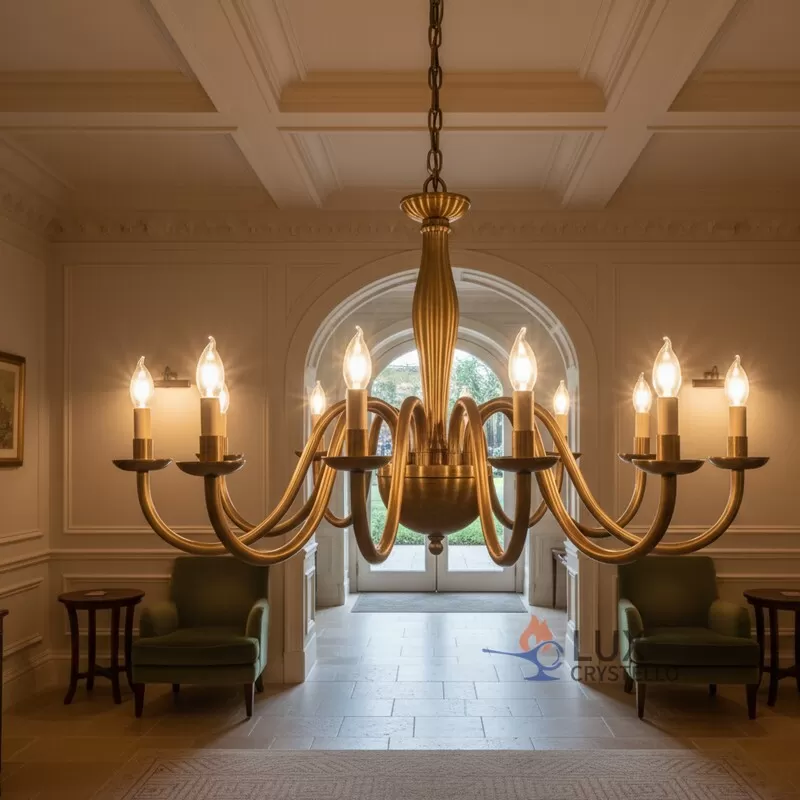
In a well-designed brass crystal chandelier, the frame should quietly support the crystal rather than compete with it. Brass tone and surface treatment play a major role here. If arms, canopy, and visible hardware do not match, the structure draws attention away from the sparkle.
Buyers should decide early whether the project calls for a softer satin brass—which is generally easier to maintain—or a brighter polished brass, which offers higher visual impact but shows fingerprints and tone variation more easily. For stock purchases, confirm current batch tone with close-up photos. For crystal chandelier OEM programs, locking a reference finish and enforcing batch matching is essential, particularly in ballrooms or corridors where chandeliers are installed in series.
Installation Reality: Assembly Time Is a Real Cost
Chandeliers rarely arrive ready to hang. They ship as multiple components: frame, arms, crystal elements, canopy hardware, and fittings. For B2B buyers, assembly complexity directly affects labor cost and project timelines. A brass crystal chandelier requiring hundreds of individually attached crystal pieces can significantly slow site progress.
Before committing, clarify what is pre-assembled at the factory and what must be completed on site. Review how crystals attach—hooks, rings, or pins—and whether the design minimizes repetitive labor. Packaging is equally critical. Crystal components should be separated to prevent rubbing, and brass surfaces must be protected against scuffs. An experienced brass chandelier supplier should be able to explain packing logic clearly and demonstrate how missing parts are avoided without shifting responsibility to installers.
Conclusion
A brass crystal chandelier earns its place in a project when it does more than sparkle. It arrives intact, installs smoothly, and maintains visual consistency across rooms and reorders. For B2B buyers, thinking in terms of "project-safe" selection reduces hidden costs—fewer delays, fewer replacements, and stronger long-term client satisfaction.
If you are sourcing a brass crystal chandelier, share your target diameter, height range, and estimated quantity. For crystal chandelier OEM development, a 2D drawing or 3D file is enough to review proportions and component structure. To speed up evaluation, include target crystal style, pre-assembly level, and spare-piece expectations—standard inputs for most crystal chandelier OEM workflows. If timelines are tight, available models can also be recommended based on your design direction and project constraints.
Elevate your space with authentic French craftsmanship. Start Your Project Today
400-123-4567
138-0000-0000